Low Voltage Electrical Wiring Orange County: Data, Audio, and Security
Walk into any newly built home in Newport Coast or an office in Irvine and you can feel when the infrastructure was planned well. Doors unlock smoothly with a badge. Music follows you from the kitchen to the patio. Video meetings feel clear and fast. None of that happens by accident. It starts with good low voltage wiring, a smart layout, and coordination between trades. I have spent years crawling attics in Mission Viejo, core drilling slabs in Santa Ana, and fishing cable through plaster in older San Clemente bungalows. The lesson is consistent: planning beats patchwork, and code compliant craft protects your investment long after the paint dries.
Low voltage wiring does a different job than your 120 or 240 volt branch circuits. It carries signal and modest power for data, cameras, access control, intercom, distributed audio, automation, and more. It lives beside the traditional electrical work, so it pays to hire a licensed electrician Orange County property owners trust, or a coordinated Orange County electrical contractor who manages both scopes without finger pointing. The best outcomes come when the same team that runs your Cat6 also knows how to protect it from electrical noise, routes it safely around lighting circuits, and bonds the racks, surge protectors, and metallic pathways together.
What low voltage covers, and why it matters locally
In Orange County, the usual suspects for low voltage wiring include structured cabling for data, PoE devices such as access points and cameras, distributed audio, TV and HDMI extenders, intercom and door stations, gate control, security sensors, and backbone fiber between closets. Residential and commercial needs overlap more than people think. A Dana Point home with three home offices, four access points, 12 zones of audio, and a rack in the garage looks a lot like a small business network. A Costa Mesa retail buildout needs ambient audio, cameras, reliable Wi‑Fi, and a secure POS network with battery backup. Local conditions come into play too. Salt air near the coast accelerates corrosion on outdoor terminations, so we lean on UV rated jacket, stainless hardware, and gel filled connectors. Santa Ana winds push dust into exterior enclosures that are not properly gasketed. Firestopping expectations are high among Orange County inspectors. If penetrations are not sealed, expect a red tag.
California uses a version of the National Electrical Code, and the California Building Code ties into fire and smoke requirements. In practice, that means the same fundamentals everywhere in the county: use plenum rated cable in return air spaces, secure cables with listed supports, separate low voltage and power conductors, label your runs, and firestop any penetrations through rated assemblies. Article references matter less to the homeowner than the result, but a crew that works to NEC Articles 725, 760, and 800, and follows TIA 568 and 569, tends to deliver systems that pass inspection and perform under load.
The bones of a reliable structured cabling system
The structured part matters. A single long patch cord run under a rug is not a system. A system begins with a home run architecture to a central location, usually a rack or structured media enclosure in a mechanical room, garage, or dedicated closet. Every data jack, camera, access point, and controller feeds back to that hub. The rack holds patch panels, a switch or two, possibly a router and firewall, a UPS, and a tidy service loop. You plan for growth with 20 to 30 percent spare capacity in patch panel ports and rack space.
Cable pathways are quiet heroes. In new construction, we staple J‑hooks or mounting rings on a predictable grid so bundles have support every 4 to 5 feet. In retrofits, we use existing chases, closets, and soffits to avoid Swiss cheesing the framing. Orange County homes with spray foam insulation in cathedral ceilings are tricky. You choose conduit early and land boxes at soffits before drywall, or you end up surface mounting later. If a client in Laguna Beach asks for hidden speakers in a finished plaster ceiling, we set realistic expectations. Cutting and patching plaster is doable, but there is dust, noise, and staging involved, and insurance for historical finishes might govern what can be touched.
Distance and bandwidth guide your cable choice. Cat6 supports 1 Gbps up to 100 meters and can handle 10 Gbps up to around 55 meters under typical conditions. Cat6a supports 10 Gbps up to 100 meters if you keep crosstalk controlled with proper spacing and termination. For long backbones that jump between floors or detached structures, multimode fiber eliminates ground potential differences and electromagnetic interference, and gives headroom for future upgrades. Ubiquitous PoE has changed the game too. Doors, cameras, access points, and even touchscreens often want 15 to 30 watts, sometimes 60 to 90 watts for pan tilt zoom cameras or multi radio APs. That power travels over the same data pair, which makes PoE budgeting as important as bandwidth. A PoE switch with a 370 watt budget can sag quickly if you have eight hungry devices. Seasonal heat in a closed garage rack in Lake Forest can shave reliability if you do not plan ventilation.
Data and networking that hold up under real use
Everyone says they need fast internet. What they often mean is consistent local network performance. If your Laguna Hills household streams four 4K TVs, uploads design files to the cloud, and runs a dozen smart devices, the internal network is where the rubber meets the road, not the advertised ISP speed. Structured cabling to every TV, office desk, and media cabinet pays off. Wi‑Fi is still crucial, but wired first makes wireless better.
For access points, a balanced design beats guesswork. A one story ranch might need three APs to cover 3,000 square feet with stucco and rebar in the walls, while a two story with open ceilings in Yorba Linda might be happy with two. We mount APs on the ceiling whenever possible to avoid beam shaping against walls, and we avoid placing them above HVAC ducts that become Faraday shields. If you insist on in‑ceiling speakers near an AP, we stagger placement to avoid interference. We also run a spare Cat6 to each AP location, coiled and labeled in the ceiling, so a future Wi‑Fi 7 upgrade does not require opening drywall.
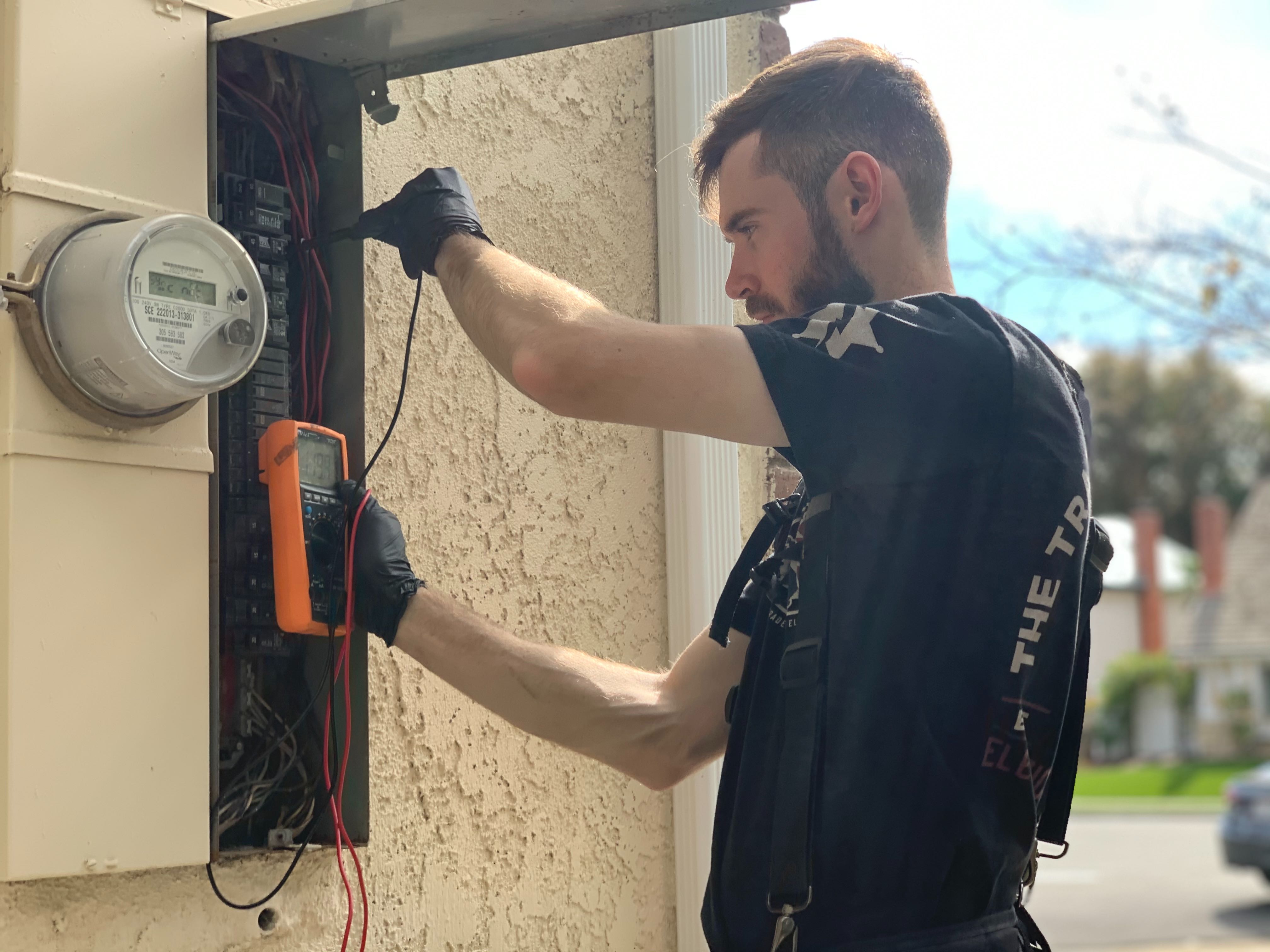
For small businesses across Orange, VLANs are not a luxury. Keeping guest Wi‑Fi off your POS network guards against the casual mistake that turns your card reader into an open door. Many offices also ask for a physically separate line for a VoIP system or a monitored alarm. A seasoned commercial electrician Orange County teams rely on can coordinate with the IT vendor, land demarcation lines cleanly, and bond the rack per code to avoid hum and to protect equipment.
Whole house audio that feels natural, not forced
Distributed audio succeeds when wire and speaker choice reflect the space, not a catalog. In older Tustin homes with lath and plaster, we lean toward surface or bookshelf speakers to avoid invasive cuts, then prewire for the day you remodel. In a new construction in Ladera Ranch, 16 gauge two conductor is fine for short runs, but 14 gauge gives better headroom for long patio feeds. For commercial settings like a fitness studio in Huntington Beach, 70 volt distributed audio with proper taps lets you add speakers later without rebalancing impedance. Prewiring separate conduits for subwoofers pays dividends, because the client who says they do not want a sub often changes their mind. HDMI over Cat6 extenders help when a client asks for a mirrored feed from a media closet to an outdoor TV. We keep HDMI runs on their own cable to prevent crosstalk and label both ends in plain language. If the patio TV says Pool TV 1 at the patch panel, your future self will thank you.
Noise and grounding are not abstract. I have chased a ground loop hum that only showed up when a garage door opener ran. The culprit was an AV rack bonded to a different point than the main service. A licensed electrician Orange County inspectors know can correct that by bonding low voltage racks to the building grounding electrode system and by keeping low voltage in separate conduits from branch circuits wherever practical. Little choices, like crossing power at right angles and maintaining 12 inches of separation when running parallel, reduce induced noise.
Security cameras and access control that actually deter
The difference between a camera system that solves a problem and one that produces grainy frustration usually comes down to lens choice, placement, and network design. In Lake Forest, a 2.8 mm lens shows a wide yard but gives up facial detail beyond 20 feet. A 6 mm lens on the same camera narrows the field and captures license plates at a gate. A good plan mixes both. For coastal installs, we pick housings rated for corrosion, route drip loops, and seal threads so salt does not creep in. For front doors, we often wire both a doorbell camera and a secondary camera higher on the soffit pointed at the approach. If the doorbell gets blocked by a package or a person standing too close, the secondary angle still captures useful footage.
Power over Ethernet simplifies deployment. Most fixed dome and turret cameras are happy at 15 to 30 watts, but pan tilt zoom units need 60 to 90 watts. You cannot plug a whole row of PTZs into a light duty PoE switch and expect it to last through a hot August. We check the PoE budget, account for cable length and voltage drop, and spec midspans or higher wattage switches where appropriate. For recording, network video recorders live best in a ventilated rack on a UPS. If a client wants remote access, we work with their IT professional to set up VPN or secure cloud relay, not a forwarded port that invites trouble.
Access control is cleaner than it used to be. Door strikes, maglocks, readers, and request to exit sensors all ride on low voltage. Code compliance is non negotiable. Egress doors must release on fire alarm and on power loss. California inspectors watch that closely. Cables to readers get 22/6 or 22/4, shielded if near noisy equipment. Strikes and maglocks get 18/2 or 18/4 depending on distance and current. We home run everything to a control panel in a conditioned space, not a hot electrical closet https://waylonizrd537.novacrestiq.com/posts/vacation-and-occasion-lighting-setup-orange-county that cooks batteries. If you want the gate to open from the same badge that opens the lobby, plan an interconnect between the buildings or run fiber under the driveway before you pour concrete.
Prewire timing and practical sequencing
Rough wiring for low voltage runs best after plumbing and HVAC but before insulation. You can see the pathways, avoid vents, and set depth in the stud bay so drywallers do not pierce your bundles. For remodels, the dance is more delicate. We cut minimal access holes, fish from attics and crawlspaces, and coordinate patching with the general contractor. Where there is no chase and no attic, surface raceway sometimes becomes the right answer, especially in a rental where invasive work is off limits.
A simple prewire checklist keeps everyone marching in the same direction:
- Rack location confirmed with power, ventilation, and UPS space
- Final device schedule with cable types and counts approved
- Conduit and back boxes installed for TVs, keypads, and outdoor devices
- Labeling standard agreed to and printed labels on site
- Photo documentation of every wall before drywall
That last item saves time years later. I cannot count the times we have pulled up old site photos on a phone in a kitchen and found the exact stud bay that hides a speaker wire.
Materials, terminations, and code details that avoid callbacks
Cable jacket ratings matter more than the color on the reel. If your cable runs through an open return air plenum, like a hallway ceiling in an office, it needs a CMP rating. Most homes with ducted returns only need CMR in walls, but occasional plenum spaces show up in custom builds. Choose UL listed fasteners and supports, and avoid nylon zip ties cinched to the point of deforming the cable. Velcro wraps are kinder, especially near terminations. Bend radius is not a suggestion. For Cat6 and Cat6a, keep bends to no tighter than four times the cable diameter to protect performance.

Terminations are where systems live or die. On Cat6, you avoid untwisting pairs more than half an inch at the jack or plug, and you keep pair order consistent to T568B or T568A throughout the system. Both work as long as you pick one. Shielded cable is overkill in most homes, but when you place data runs near large motors or elevators in a commercial project, shielded variants and metal jacks tied to ground can prevent headaches. With HDMI over Cat6 extenders, stick to solid copper conductors, not copper clad aluminum, and honor the manufacturer’s maximum run lengths. CCA looks like a deal until extenders flake out under 4K HDR loads.
Firestopping is not a sticker. When we core a hole through a rated floor for a riser bundle in an office near John Wayne Airport, we install a proper sleeve, a firestop device, and seal it per the system listing. Inspectors check the numbers on the red label against an approved assembly. For penetrations in residential garage walls that separate living spaces, we pack mineral wool and seal with intumescent, then leave the can on site for the inspector. Little habits like that avoid return trips.
Testing, labeling, and documentation
I would rather find a bad punchdown at 2 pm on a Tuesday than at 10 pm when a client is moving in tomorrow. We certify data runs with a cable analyzer where budgets allow, or at minimum we validate with a network tester that checks wire map, length, and PoE load. For audio, we pop a test tone through and verify polarity. Cameras get named at the NVR with labels that match the jack numbers. We keep an as‑built drawing, even if it is a marked up floor plan, and we email a PDF copy to the owner along with admin credentials in a sealed envelope. If a residential electrician Orange County homeowner hires for future work opens a clean rack with labels and a diagram, you have paid it forward.
Choosing cabling and media without guesswork
Clients often ask whether to pull Cat6, Cat6a, or fiber. This quick comparison helps set expectations:
- Cat6: Cost effective, easy to terminate, supports 1 Gbps to 100 meters and 10 Gbps to around 55 meters. Great for most residential drops and typical cameras and access points.
- Cat6a: Thicker and a bit harder to handle, but 10 Gbps to 100 meters with better crosstalk control. Right for backbones in larger homes and small offices, and for media rooms that move a lot of data.
- Multimode fiber: Immune to EMI, long runs with huge headroom, perfect between buildings or across large commercial floors. Termination and gear cost more, but it solves distance and bonding problems cleanly.
In real projects, we mix them. Cat6a from the ISP demarc to the core switch gives breathing room. Cat6 to rooms and cameras keeps cost reasonable. A two strand fiber between garage and ADU in Garden Grove future proofs the link without reinventing the wheel.
Integrating with the rest of your electrical scope
Low voltage rarely lives alone. If you are doing an electrical panel upgrade Orange County inspectors will review, plan for the low voltage rack power and UPS at the same time. If you schedule EV charger installation Orange County utilities appreciate load calculations that consider the new car charger and the rack UPS. Generator installation and transfer switches often feed critical low voltage loads like security and networking. We set a dedicated circuit for the rack, then program the UPS for graceful shutdown if the outage exceeds a safe battery window. No one wants to come home from a long weekend to a corrupted recorder.
Lighting also intersects. Smart home wiring Orange County homeowners often request moves control out of the walls and into keypads and centralized panels. That means LV control wire to switch locations, and careful separation from 120 volt conductors. For recessed lighting Orange County remodels, we coordinate fixture placement with access point and speaker locations so RF and audio coverage stay balanced. For outdoor lighting Orange County properties with hardscape plans, we stub conduit to pillars and plan separate low voltage runs for lighting and for cameras or intercoms to avoid crosstalk.
When something breaks, it is helpful to call a local electrician Orange County residents recommend who is comfortable with electrical troubleshooting on both sides. An Orange County electrical repair that starts as a tripped breaker can reveal a rack outlet on a shared GFCI in a garage. A same day electrician Orange County property managers rely on can separate that onto a dedicated arc fault breaker and keep the rack online. In true off hour emergencies, a 24 hour electrician Orange County businesses keep on speed dial can triage a downed camera system and at least get core security online until full repairs.
New build versus retrofit, and what it means for cost
New construction is the ideal. You can prewire every likely location, land conduits where equipment will live, and cap spare runs for contingencies. The rough labor hours per drop tend to be half of a retrofit. Material cost is predictable, and patching is minimal. On a 3,000 square foot new build in Aliso Viejo, a robust low voltage package might include 18 to 24 data drops, four access point locations, eight to twelve audio zones, six to eight cameras, front gate and door stations, and HDMI runs to TVs, all feeding a tidy 20U rack. Budgets vary, but for planning, many homeowners allocate a few percent of the construction cost to low voltage infrastructure.
Retrofits swing wider. Fishing cable through existing walls, working around insulation, and patching finishes add time. An older home in Orange Park Acres with plaster and no attic access can double the labor per drop. You will also spend on touch up paint, plaster repair, and sometimes on pathway compromises like surface raceway in utility spaces where opening walls would be unreasonable. That does not mean you should wait for a remodel. A focused retrofit that lands wired network at key points, adds three or four cameras, and brings Wi‑Fi access points down from attic heat into the conditioned space can transform daily life without leaving your home in disarray for weeks.
Permitting, inspections, and communication with AHJs
Not every low voltage scope needs a separate permit. Many jurisdictions in the county allow low voltage work under the umbrella of the main building permit, or with an over the counter low voltage permit for commercial spaces. That said, access control that ties into egress can trigger more scrutiny, and anything touching fire alarm is its own licensed discipline. We maintain good relationships with building departments from Anaheim to San Clemente, call ahead when a design has unusual elements, and bring cut sheets to inspections. If a plan reviewer asks how an egress door will fail safe on fire alarm, we can point to the relay module and show wire diagrams. That level of clarity speeds approvals and avoids costly rework.
Maintenance and upgrades that extend system life
Cabling lasts decades if it is installed cleanly, supported, and protected. Electronics age faster. Consumer grade switches and recorders may last five to seven years, while enterprise gear runs longer. We schedule a yearly check on business systems to update firmware, test UPS batteries, clean filters, and verify camera focus and field of view. For homes, a light touch every couple of years is often enough. If you add an electric vehicle charger Orange County energy loads shift, and you may want to reevaluate UPS runtimes and generator priorities. When you remodel a kitchen and shift appliances, grab the chance to pull a spare data run to the new island location. It costs little when walls are open and a lot when you try later.
When you move or sell, a labeled, documented system shows care. Buyers in Orange County expect connectivity. A home with neat patch panels, labeled ports, and a small cheat sheet at the rack stands out. That is also when it pays to have worked with a top rated electrician Orange County agents know by name. Their letter certifying that the low voltage gear is bonded, powered correctly, and left in standard configuration calms nervous buyers and appraisers.
Choosing the right partner for the work
The internet offers a long list of options when you search electrician near me Orange County. Experience and process separate the solid pros from the rest. Look for a licensed electrician Orange County authorities recognize, not a handyman who dabbles. Ask to see a recent as‑built. Ask how they test and label. Ask how they will coordinate with your general contractor and with your IT or security vendor. A reputable Orange County electrical contractor will discuss tradeoffs openly. For instance, they will tell you when Cat6 is plenty and when Cat6a or fiber is worth the premium. They will suggest a slightly larger rack if the equipment count is already pushing limits. They will schedule patch and paint as part of a retrofit, not leave you with open holes.
Price matters, but cheap work gets expensive fast. An affordable electrician Orange County homeowners return to will build a scope that fits your needs and future proofs within reason, not pad the bill or cut corners. If your schedule is tight, a same day electrician Orange County residents call for urgent help can stabilize a failing switch or isolate a short until a full crew arrives. For full scope builds, capacity and craft win. It is also fair to ask for references on similar projects, residential or commercial. A commercial electrician Orange County facility managers trust may be perfect for your office but overkill for a cottage, and vice versa.
Two short stories from the field
A Laguna Niguel client called after moving into a home built in 2007. Wi‑Fi died in the far bedrooms, and Zoom calls stuttered. The builder had run a single Cat5e to the family room. We opened two small sections of drywall, fished Cat6 to four key locations, and added two ceiling access point drops. We moved the modem and router off a hot shelf in a laundry closet into a small rack with a UPS. Internet service did not change, but the house felt different. The kids stopped tethering phones in the hallway, calls became smooth, and streaming worked without buffering. Total downtime for the household was a single afternoon.
A Newport Beach retail tenant improvement wanted to repurpose existing wiring. The old camera runs were copper clad aluminum, the rack sat near a water heater, and the PoE switch ran hot all summer. We proposed new Cat6 home runs, a ventilated wall mount rack away from plumbing, and a proper UPS. We also mapped the loads and found that the rack shared a circuit with the back room mini fridge. We routed a dedicated circuit with surge protection, bonded the rack, and replaced two failing cameras with a mix of 4 mm and 6 mm lenses to nail coverage of the entry and the cash wrap. The shop rode out a brief outage a month later without losing recordings, and the owner finally stopped resetting the switch on hot afternoons.
The bottom line
Low voltage wiring is the quiet infrastructure that lets your Orange County home or business work the way you expect. It touches daily life in small ways that add up. It is also one of the easiest places to build in future value if you plan it with intention. Whether you are coordinating a whole home rewiring Orange County remodel, scheduling outlet installation Orange County upgrades, or mapping lighting installation Orange County changes that tie into your control system, loop your low voltage plan into the conversation early. Choose materials that match the environment, place devices with purpose, and test before furniture arrives. If you need help, work with the best electrician Orange County clients recommend for integrated projects, or at least with a local team that communicates, labels, and documents as if they will be the ones called to service it years from now. Your network, your audio, and your security will feel simple from the outside. That is the point.